


Page 3 - CatalanoInfuso&Sulli_1995
P. 3
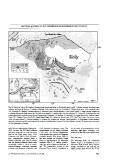
TECTONIC HISTORY OF THE SUBMERGED MAGHREBIAN CHAIN OF SICILY

'.. /.1' .                                             '····-- -·.. •-
· r --- ·· ----- Ty·rrhen1an ·Sea·
.......++++++++·~                                                       _.__ _     ·.
                                                       +-+,,

                                                                                   Sicily

                                                                                           ,'

                                                                                       ··,

                                                                                                           lQO /cm

Fig. 2. Structural map of the Sardinia Channel-Sicily Straits area based on the existing seismic grid. 1, Eastern Sardinia structural units
emplaced during early Miocene; 2, Kabilian-Calabrian Units emplaced before late Langhian; 3, Sicilian-Maghrebian Units emplaced before
Late Tortonian; 4, Deformed Tortonian deposits; 5, Deformed Lower Pliocene deposits; 6, Gela Thrust system; 7, Meso-Cenozoic undeformed
or slightly deformed foreland covered by Plio-Pleistocene deposits; 8, Uplifted Meso-Cenozoic substrate; 9, Thrusts; 10, Post-Messinian half-
grabens tectonically inverted during the late Pliocene-early Pleistocene; 11, Syncline; 12, Anticline; 13, Norma/ faults. STF, Sardinia Thrust
Front; DTF, Drepano Thrust Front; ETF, Egadi Thrust Front; ATF, Adventure Thrust Front; GTF: Gela Thrust Front. The tectonic scheme
in the left corner shows: (1) Corsica-Sardinia; (2) Calabrian Are, Kabilias and 'internai' flysch ophiolites; (3) Maghrebian-Sicilian-Southern
Apennine imbricates and deformed foreland; (4) foreland and mildly folded foreland (Tunisian, Hyblean, Apulia); (5) superimposed extension;
(6) Plio-Quaternary volcanoes.

early Miocene deformation (Agate et al.,  their detached terrigenous cover. The    be the result of post-Messinian out-of-
1993). In turn, the NW Sicily offshore    emplacement of the Kabilo-Calabrian      sequence high-angle thrusting, that
has been recognized as a marine exten-    Units onto the Sicilian-Maghrebian       followed earliest Miocene emplacement.
sion of the land chain (Selli, 1974;      rocks predate the end of the Langhian
Catalano et al., 1985). A NW-SE geolo-    (Amodio Morelli, 1976; Nigro, 1992). In  The outer sector
gica! cross-section, derived from a       the area studied the Drepano Thrust
seismic reflection grid (Fig. 5), shows   Front is superimposed on Messinian       The reflecting body on Adventure
that the Kabilo-Calabride thrust units    horizons (Figs 3, 5): similar relation-  Plateau (Figs 3, 4) consists of: (a) a
tectonically overlie a stack of south-    ships are seen in places on land and at  deformed, 3000 m-thick, thinly layered
eastward-vergent imbricates assumed       sea. The present-day setting of the      wedge, bounded to the NW by the
as basin and platform carbonates and      Drepano Thrust Front is considered to    Egadi Thrust Front and to the SE by

© 1995 Blackwell Science Ltd, Terra Nova, 7, 179-188.                                                               181

