


Page 2 - CatalanoInfuso&Sulli_1995
P. 2
R. CATALANO ET AL.

                                              TYRRHENIAN SEA                                      The inner sector

                                                                                         39"      The inner segment of the Sicilian-
                                                                                                  Maghrebian chain is boundeci to the
               , ·.ZOO                                                     37"                    north by the Drepano Thrust Front
                                                                                                  (DTF, Fig. 2); this outcrops along the
               \                                                                                  Western Bank and the Elimi Chain
                                                                                                  (Southem Tyrrhenian Sea). The south-
                 i                                                                                em boundary is representeci by the
                                                                                                  NNE-SSW trending Egadi Thrust Front
                l                                                                                 (ETF, Figs 2, 3). In this sector, the
                 \ r-::~:~·)                                                                      geometrically highest tectonic units
                                                                                                  show the reflecting character of a thinly
                  '·'(···.. ···...                                                                layereci succession, which is interpreteci
                                                                                                  as Numidian flysch, or equivalent
                               ;                                                                  clastics. Similar rock units are known
                             /                                                                    along the adjacent Sardinia-Tunisia
                                                                                                  segment in La Galite Archipelago and
o 60/cm                                       LINOSA GRABEN                                       Skerki Bank (Tricart et al., 1993). The
                                                                        l                         wecige structurally overlies stackeci
            l                                                                                     thrust sheets that show the acoustic
                                                               14"                                character of a deep-water carbonate
      IO"                                                                                         facies, of assumeci Mesozoic age.
                                                                                                  Equivalent facies and age rocks (Upper
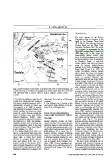
Fig. l. Sardinia Channel, Northwestern Sicily offshore and Straits of Sicily morphology. The      Triassic pelagic limestones; Di Stefano
studied area (grey) is crossed ùy some geologica/ and seismic profiles (black lines) illustrated  and Gullo, 1993) crop out on the Egadi
here. Calibrating wells: 1, Tania; 2, Noemi; 3, Onda; 4, Orione; 5, Venere; 6, Pina;              lslands, as part of a tectonic unit thrust
7, Leone.                                                                                         over carbonate platfonn rocks. This
                                                                                                  confinns that the basinal units, in turn
2 The I<abilian-Calabrian units (Fig. 2)      Gela basin that acteci as a Pleistocene             overthrust thicker thrust sheets, formeci
consist of an imbricateci thrust wecige of    forecieep;                                          by Triassic-Liassic carbonate-evaporitic
Hercynian crystalline basement with a         4 The foreland area is locateci in the              platfonn and Jurassic-Oligocene deep-
metamorphic overprint of Alpine age           southeastem Sicily offshore and in the              water deposits. The shallow-water car-
(Compagnoni et al., 1989) as recently         Sicily Channel (Pelagian Sea).                      bonates are calibrateci by well stratigra-
also describeci in Southem Calabria. On                                                           phy and partly outcrop in the Egadi
seismic proffies, the thrusts are partly      THE SICILIAN MAGHREBIAN                             lslands. They can be correlateci with the
sealeci by Lower Miocene arkosic de-          CHAIN AND ITS THRUST FRONT                          succession cropping out on land that
posits of foreland basin type. Middle                                                             relate to the Panormide and Pre-Panor-
Miocene-Pleistocene clastics follow           The Chain                                           mide palaeogeographic domains (Cat-
above, markeci by regional unconformi-                                                            alano, 1987). Basinal Cretaceous-early
ties (Barbieri et al., 1984). The I<abilian-  Seismic reflection profiles are inter-              Miocene packages were detacheci from
Calabrian tectonic units overthrust the       preteci to include: (1) an inner strongly           their Palaeozoic-Mesozoic substratum
Sicilian-Maghrebian sector of the chain       shorteneci segment, which extends from              and thrust over the stackeci carbonate
along the Drepano Thrust Front (Figs 2,       the Western Bank southeastwards to the              platfonn units (Fig. 4). The stackeci
3 and Catalano et al., 1985);                 Egadi lslands and eastwards to the NW               units are generally unconfonnably over-
3 The Sicilian Maghrebian sector con-         Sicily offshore; (2) an outer, less de-             lain by prograding sequences of Torto-
sists of a large tectonic body more than      fonneci, tectonic element extending                 nian terrigenous and clastic carbonates,
12 km thick, fonneci of several imbricate     across the Adventure Plateau; and (3)               of Messinian evaporites, early Pliocene
thrust units. A thrust front occurs           a defonneci foreland forming the wes-               pelagic marly limestones and Plio-
offshore in southem Sicily, between           tern and southem Sicily offshore, as                Pleistocene clastics. The Pliocene-Pleis-
Gela and Sciacca (GTF, Fig. 2). A             well as southem Sicily mainland (Cat-               tocene basin ffiling appears to be
tectonic wecige of thin-skinneci thrust       alano, 1988). Detaileci geologica! sec-             deformeci by growth faulting_ followeci
sheets of mostly Oligocene-Lower Pleis-       tions based on the seimic lines cross the           later by inversion tectonics (Catalano et
tocene rocks is sandwicheci there within      submergeci body along a NW-SE line                  al., 1988; Catalano and Milia, 1990).
Pleistocene sedimentary packages of the       (Fig. 3).
                                                                                                    The inner sector apparently can be
                                                                                                  correlated with structures forming the
                                                                                                  Northwestem Sicily offshore (Figs 2, 5).
                                                                                                  The stratigraphy and tectonic structures
                                                                                                  indicate a common evolution during the

180 © 1995 Blackwell Science Ltd, Terra Nova, 7, 179-188.

