


Page 6 - Sulli_eall_2012
P. 6
146                                                                                              Sulli A. et al.

Vito Lo Capo peninsula (Fig. 1). Here, a

sedimentary basin, more than 1000 m

deep, trends in a general north-south di-

rection across the upper slope.

     The continental slope deepens to

1000 m, with gradient of 4-9°, and is in-

cised by numerous gullies and major can-

yons (Fig. 2). Slumping, scours and small

turbiditic fans are located at depths from

200 to 800 m, confirming the occurrence

of gravity-driven slope instability (Agate et

al., 2005).

     The coastal belt includes several

rocky cliffs along the promontories border-

ing the Gulf of Castellammare (Capo San

Vito and Capo Rama), while a long beach,

up to several tens of meters wide, extends

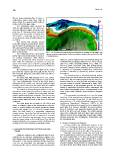
in the central sector.                         Fig. 5 - 3D shaded relief model (view from North-West) showing several gullies and
       The continental shelf is wave-domi-     canyon headscars indenting the shelf break along the southeastern sector of the Gulf
                                               of Castellammare.
nated, with a mean tidal range of about 21

cm (Istituto Idrografico della Marina,                         units). As several Authors have documented along oth-

1982). The predominant wave direction is from north-           er Mediterranean margins (Chiocci et al., 1991; Correg-

west, while the southwest and southeast are less fre-          giari et al., 1996; Hernandez-Molina et al., 1994; Tes-

quent. Storm waves occur in winter to spring (November         son et al., 2000; Trincardi & Field, 1991 among others),

to May) and vary in approach direction from northwest to       the cyclic change of these attributes almost certainly is

northeast.                                                     a response to subsequent sedimentary environment

     The continental shelf is 8 km width on the central        variations controlled by Quaternary eustatic sea-level

part and in the eastern side of the gulf, but it is very nar-  fluctuations.

row or absent along the rocky cliffs of the San Vito Lo        The unconformity is a subaerial erosional surface

Capo peninsula.                                                formed during the last eustatic sea level fall ended in the

     The inner shelf, with gradient of 0.7°-1.0°, encom-       LGM (20-18 ka) and shaped again during the Late Qua-

passes 0-50 m, while the outer shelf has a slope of 0.9°-      ternary-Holocene sea level rise that generated a “trans-

1.2°. The central-western sector of the inner shelf is         gressive surface of erosion” (Nummedal & Swift, 1987).

characterized by convex and concave breaks-in-slope            As consequence of this polygenic genesis, the uncon-

bounding wave-cut terraces and paleo-cliffs; the seabed        formity is punctuated by incised valley, submerged cliff

is punctuated by rocky outcrops and small biohermes.           and isolated topographic relieves corresponding to out-

     The Holocene coastal wedge is thicker in the cen-         crops of the rocky substrate, mud volcanoes, biogenic

tral-eastern sector where the sea bed is rather even and       mounds.

displays an up to 2° gradient in the inner shelf; the bath-    This prominent unconformity is in turn the lower

ymetric gradient decreases seawards. The present day           boundary of the sedimentary succession deposited dur-

shelf margin morphology arises from a former wave-cut          ing the last eustatic change (last 125 ky), which can be

terrace mostly buried beneath a thin sheet of Holocene         interpreted as a IV order depositional sequence (Late

sediments.                                                     Quaternary Depositional Sequence, LQDS). In the

     The shelf break lies at depth of 130-190 m and            LQDS we recognized four systems tracts, separated by

shows a scalloped shape in the southeastern sector be-         basin-wide key surfaces identified by lateral termina-

cause of several gullies and canyon headscars indent-          tions of reflectors, and deposited during specific seg-

ing the shelf margin (Fig. 5). Out of the canyon head-         ment of the last sea level change. The LQDS extends

scars, the shelf break is a prograding, depositional           above the continental shelf and upper slope along the

straight feature. Along the San Vito peninsula the shelf       different sectors of the margin with considerably variable

break lies at depth of 60-100 m because of structural          internal geometry and stratigraphic relationships with

control and abundant retrogressive mass movement               the underlying units.

along the upper slope. In the small Bay of San Vito the

continental shelf is very narrow and the shelf break lies      5.1 Gulfs of Termini and Palermo

at depth of 80-100 m reflecting a structural control.          In these sectors the stratigraphic features of the

                                                               LQDS and underlying Pleistocene succession are very

5. SEISMOSTRATIGRAPHIC SETTING AND FEA-                        uniform, so they will be illustrated together. We will de-

TURES                                                          scribe the systems tracts from the older to the younger.

                                                               Deposits accumulated during the sea level fall

     Along the study area the continental shelf is char-       form progradational sedimentary wedges perched along

acterized by an extensive unconformity eroding a sea-          the shelf margin (Figs. 6-7). They are imaged by high

ward dipping mixed (lithoclastic/bioclastic) Pleistocene       resolution seismic profiles with reflection-free seismic

succession. In the seismic reflection profiles these hori-     pattern or thin, oblique tangential/parallel reflectors, 3.5°

zons can be assembled into packages of reflectors              seaward sloping, locally involved in slumping. Wedges

showing specific seismic attributes (seismostratigraphic       are up to 50 ms (t.w.t.) thick and up to 2 km wide; land-

