


Page 2 - Brain_morphology_2008
P. 2
G. Palmieri et al.


              To increase the possibility of success in bluefin  Immunohistochemistry
             tuna domestication, a better understanding of the  De-waxed and re-hydrated tissue sections were
             reproductive biology of this fish is required, with  immersed in 3% H2O2 for 10 min to suppress
             special focus on the brain-pituitary-gonad axis.  endogenous peroxidase activity and then rinsed with
              The aim of this paper was i) to provide data on  distilled water and phosphate buffered saline (PBS,
             the gross morphology of bluefin tuna brain; ii) to  0.01M, pH 7.4) containing 0.15 M NaCl, 1%
             describe the main diencephalic nuclei involved in  bovine serum albumin (BSA) and 0.5% Triton X-
             reproductive function; iii) to immunolocalize, in  100. Non-specific binding sites for immunoglobu-
             both the forebrain and midbrain, the neurons      lins were blocked by incubation for 30 min with 5%
             responsible for GnRH synthesis.                   normal goat serum (NHS) in PBS containing 1%
                                                               BSA. Sections were then incubated for 15-24 h at
                                                               4°C in a moist chamber with nine different dilutions
             Materials and Methods                             (1:100, 1:500, 1:1000, 1:1500, 1:2000, 1:2500,
                                                               1:3000, 1:4000, 1:5000) of polyclonal primary
             Sampling                                          antisera against salmon(s)GnRH, chicken(c)GnRH
              Both brain and pituitary were collected from 18  and sea bream(sb)GnRH, used to determine the
             sexually mature bluefin tuna killed during the peri-  optimal working dilution. Anti sGnRH (lot n. 1667)
             od of natural spawning of the species (June-July,  and anti cGnRH (lot n. 675) were kindly supplied
             2005 and 2006) at several  locations in  the      by R. P. Millar; anti cGnRH (lot n. 6) and anti
             Mediterranean Sea.The total body mass and brain   sbGnRH (lot n. 691) were kindly provided by M.
             mass of each specimen were measured to the near-  Amano.
             est kg and to 0.01 g, respectively.                All antisera were diluted in 5% BSA/0.01 M
              Samples were fixed in 10% buffered formalin for  PBS/0.5%  Triton X-100, pH 7.4. The resulting
             24 h, dehydrated through graded alcohols, cleared  suitable working dilutions (no background) for each
             in xylene and embedded in paraffin wax.Twelve- or  antiserum are given in  Table 1. The slices were
             five-µm thick sections were cut for morphology or  rinsed in Triton-PBS for 15 min and incubated with
             immunohistochemistry investigations, respectively.  biotinylated secondary antibody for 30 min to be
                                                               washed in PBS and re-incubated in avidin-biotin-
             Encephalization quotient and morphology           peroxidase complex (ABC) (Vector, Burlingame,
              The encephalization quotient (QE) was calculat-  CA). Peroxidase activity was visualised by 10-min.
             ed as the ratio of actual brain size to expected brain  incubation with Vector DAB Peroxidase Substrate
             size using the formula:                           Kit (Vector, Burlingame, CA), which produces a
                                                               brown precipitate. Finally, the sections were coun-
                              QE = EA EE  -1                   terstained with hematoxylin, dehydrated and
                                                               mounted.
             where EA = actual brain mass and EE = expected     Negative controls were performed by: (1)
             brain mass.                                       replacement of primary antibody with NGS, and
              The EE for bluefin tuna was calculated by the    (2) omission of primary antibody.
             allometric equation for the brain mass to body
             mass relationship (Log10 brain mass = 0.5301
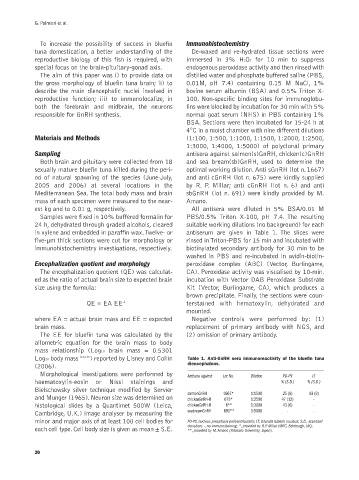
             Log10 body mass  0.8735 ) reported by Lisney and Collin  Table 1. Anti-GnRH sera immunoreactivity of the bluefin tuna
             (2006).                                           diencephalons.
              Morphological investigations were performed by   Antisera against  Lot No.  Dilution  PO-PV  LT
             haematoxylin-eosin or Nissl stainings and                                        % (S.D.)  % (S.D.)
             Bielschowsky silver technique modified by Servier
                                                               salmonGnRH  1667*    1:1500     25 (8)  43 (9)
             and Munger (1965).Neuron size was determined on   chickenGnRH-II  675*  1:2500   47 (12)    -
             histological slides by a Quantimet 500W (Leica,   chickenGnRH-II  6**  1:3000     43 (6)    -
             Cambridge, U.K.) image analyser by measuring the  seabreamGnRH  691**  1:5000      -        -
             minor and major axis of at least 100 cell bodies for  PO-PV, nucleus preopticus-periventricularis; LT, lateralis tuberis nucleus; S.D., standard
                                                               deviation; -, no immunostaining; *, provided by R.P . Millar (MRC, Edinburgh, UK);
             each cell type.Cell body size is given as mean ± S.E.  **, provided by M. Amano (Kitasato University, Japan).


             20

